One of the main pillars of Wikreate as "360° communications meets social networking" is the establishment of our commitment to our community. Our concept of social networking goes beyond having business relationships with professionals in advertising.
Our goal is also to strengthen corporate social responsibility and give back—or in the case of our newest pro bono project, help NGOs like the Ayala Foundation, USA (AFUSA) give back.
AFUSA and GILAS
Ayala Foundation's shining star right now is GILAS (Gearing Up Internet Literacy Access for Students) which is designed to provide internet to the Phillippines' 6300 public schools. As of May 8, 2008, GILAS has connected 1,750 public schools, giving hundreds of thousands of students a chance to go beyond the dusty trails that lead away from their home towns.
The Philippines is an archipelago of 7,107 islands at low tide. But topography is not the only barrier to solving the lack the web connection. A shortage of funds, and an abundance of mismanagement and bureaucracy in national and local government makes it difficult to deliver the most basic services to 90 million Filipinos. Computers and pipes and tubes is forced low on the list of priorities.
Ayala Corp and Ayala Foundation, Inc., are strong advocates of civic duty, ethical business practice, and grassroots development to improve the lives of the people. It is because of these high standards and care for others that we are proud to make their mission our own.
The importance of internet activity to Wikreate
The experience and success of Wikreate relies heavily on the internet. It allows us to conduct business with suppliers abroad, deliver creative solutions instantaneously, and keep in touch with friends and news sources. The wiki platform is a new, powerful tool that allows more, open, and fresh work between collaborators that is as rich as the bench of players is deep. Such is the Web2.0 mentality that, face it or not, will rule the offline world as well as the online.
For this GILAS project, the media is the message and the message is:
* Connecting the best and the brightest volunteers
* Shining light on the undiscovered
* Teaching the underprivileged, and,
* Giving hope to the near-forgotten islands of poverty.
Wikreate's call to action
There are 3.5 million Filipinos in the US. Presently, half of these are living in California. The challenge is to reach these using little more than AFUSA's database of 7,000 emails, a smattering of volunteer groups on Yahoo! groups, and the tools that will open up the hearts and minds of the new generation of Americans who have ties, or once had ties, to the Philippines.
Seven thousand contacts. Seven thousand, one hundred seven islands. At low tide.
Thursday, May 8, 2008


Saturday, April 26, 2008
A connection with the past
I didn't know whether I've said this in a previous blog, but whether I have or not, it doesn't matter because what I'm about to say is true.
I've missed the intentional and oft invasive manner of the Egyptians. People that you meet on the street will take your hand and be your best friend for at least as long as it takes to make a sale. Like I told my friend, the cosmopolitan universe of Egypt has lasted long before there were steamships to take white people over there. Ever since the Romans were expanding their frontiers and coming home and made a detour before they arrived to their mothers and wives, they passed by the oldest city in the world to experience something older than they.
Because of this environment—this constant motion of strangers through their land—their behavior has been influenced to accept and accommodate the influx of tourists and people from far away entranced by the history. The resilience of those who live in its shadow, and the transient nature of its survival, is an energy in and of itself, generating the fascination from within.
They speak many languages in Egypt (although getting into a taxicab whose driver doesn't speak a word of English or Filipino except for 'Coca Cola' isn't rare at all, so check and double check your transportation's multiliguisticality applications) and hawkers and touts on the street will not stop at rattling off some Romance or Baltic tongue to wow you into buying something.
This is not ever to say that all Egyptians you meet are marrying you off to their sister, brother, goat, or date palm). I guess that depending on their social status and the nature of their business, some will befriend you because networking is as (or more) important to them than the fast buck that they may or may not make depending on how fast they are or gullible you are. For example, I befriended this bunch of gentlemen, Aly Baba and his son, Hussien, and nephew, who ran a restaurant in Luxor. A great and educated bunch, they welcomed me with the class and suave of international men of mystery. They are certainly into being your friends for the long haul. People like these, whom you can make a mental, emotional, and/or philosophical promise to hold dear and are likewise throwing themselves into your path, as a fellow tourist of Life itself, are the ones you should keep.
People who have 6,000 years of heritage have no misgiving about eternal life and the issuing religions that market this wondrously incongruous concept. More than anything, the transience that they see in the everyday is but a 24-hour cycle of their God, Ra. So fleeting, so predictable, so essential, but so insignificant. The mere occurrence of the sunrise and sunset can never live up to the presence of the life-giving spirit.
If you're unsure about people, and their intentions, maybe you should go to Egypt, and get the depth and breadth of sincerity, warmth, and love that has existed fall this time.

I traveled on the Nile for 2 days like this, just drifting with the ancient tide.
Thanks to GNU/Wikipedia for this image
Monday, April 21, 2008
The Biking 351st
I have always envied cyclists, in-line skaters, skateboarders, and to a lesser extent, skiers, snowboarders, and surfers.
Independence has always been HUGE for me. Be it that I was over protected, the youngest of five children, or raised with a sense of pride that grows without the benefit of sunlight, I have always—will always—want to do some things entirely on my own. Biking is the perfect example of this innate desire; as of this month, now known as "The Biking 351st" and heretofore known as "April," I am an independent traveler.
I went to Egypt all by myself last September and the mix of fear and excitement still fills me whenever I look down at the mid-cuts that I wore from Cairo to Dahab. I wore those shoes out good. And along with the fear and excitement swells a sadness. A sadness that all my walking in this nascent West Coast City will destroy these shoes and render them more decrepit than the 4,000 year-old rock, stone, and sand formations that it climbed. And where I am now—it is the farthest that one can go from that first step of civilization without crossing a dateline and being sent back to it. I will preserve these shoes as I pedal myself on to much newer, but ironically, more familiar things.
I first took a journey completely alone when I was a child of but 11. We lived in a suburb called San Juan in Metro Manila, about 10 miles from the financial and medical heart of the city, Makati. The reason I mention the word medical is that my mom went into surgery to remove her cataracts in a procedure that nowadays would be considered obsolete, even archaic. She was bedridden and blind for days, gauze pads over her eyelids. On the first day of her surgery, a summer in 1990, I went out of my house. Walked about 300 meters to the busy traffic in Pinaglabanan, and boarded my first jeepney solo. At EDSA, I had to find a bus that advertised my destination: Ayala.
Different modes of travel force you to think vastly differently. Driving or riding a ca, we think of one way roads, intersections, and signal lights. On buses, we think of landmarks, bus stops, and transfers for our way back. Walking, we think of shortcuts, diagonal lines, holes in cyclone wire fences.
I picked up a Japanese proverb in Egypt, "He who travels alone travels fastest." Riding my bike around the city has given me a whole new perspective of the streets and the people and the traffic. For now I have to look out for both pedestrian and automotive traffic. I also have to look at landmarks, intersections, but I also have to look out for potholes, inclines, Muni streetcar tracks, opening doors from parked cars. I also have to learn not to look when a car zips right by me with six inches to my left. But as with all my modes of transport, I have learned to love the independence, the mobility, and now, the pleasure of wind in my face, the levitation from the hard, dirty pavement, the autonomy expressed in speed, my contribution to being a responsible member of my planet, these are things that are unequaled by walking, driving, or riding a bus. I am a singing, smiling, sustainable development on two wheels, healing scabs and all.
Saturday, December 15, 2007
HFR (How Random)
The timbre of a bell in a fire alarm is equal to or more than the sound of the firefighters' arrival. I learned this this morning, at 2:49. I had some friends over and we were just winding down when a persistent ring rang through the apartment like a banshee in your head. I walked out, confused, wondering whether it were a prank. But the smell of something burning told me it was something creeping up. My neighbor he told me to call 911 and I got on the phone and called and beat on doors and walked down the building trying to get people awake and some did and told them to get out of the building and stay low and told the lady the address and told her there was a fire between the second and third floors and while I was knockin on doors almost walked into this apartment on the floor I will not identify. It was a couple who had burned some food real bad.
And I was like, It smells like smoke in here. Is it coming from here? I said. And they were like, yeah we burned some food, and I said, you burned some food? I said. And they said, yeah, we burned, like, food, like it was nothing. in the meantime, I walk downstairs to get out and the firemen storm in and usher in the first sense of sense in the night, telling them, it was burned food, and telled them where.
I lingered long enough to watch them disable the fire alarm and fiddle with the hallway emergency switch before I thanked them and went up and rejoined my party, who had by then, as you would imagine, were thoroughly spooked out by this strict confluence of events.
When the firemen arrive, I tell you, and you are still alive so that you can see them walking in all calm and shit, you are saved. That is the time to give praise. The whole event was so surreal though. Like, as I would use to like to call it, a Reader's Digest Drama in Real Life story.
Big fan of Reader's Digest, by the way. If you have kids, let them read that. It's got comedy, articles, pictures, and Drama in Real Life. Great bathroom reading.
Thursday, November 22, 2007
What is Blogged and Written and Read all over?
So I was going over my friend's blog on interesting things about China. One of the
more interesting ones in this specific entry were the mis-signed announcements all around that one would need tae bo like stretches of the imagination.
To be fair, one must understand that the difference between Chinese and English languages is huge. Most of the western world uses letters that represent phonemes. The letters construct our words into primarily sounds and, secondly, textual signs (one must sound out a word to begin the association between the letters c-a-t and the clawed feline).
For the Chinese (apparently) it's a combination of pictures (like the hieroglyphs of Egypt) and phonetic complexes that consist of semantic elements that indicate meaning and phonetic elements that "arguably once indicated pronunciation."
That said, for a Chinese sign-maker to even begin to translate "Floor is slippery when wet" from Chinese to Engrish, he would probably have actually lose his footing on some slick pavement, knock himself upside on the head, and then write down the first English words that bounce around in his brain. Hence, this sign.
This phenomenon of mis-signing isn't endemic to China. My travels to Egypt were sandwiched between two trips to London, England. The brits themselves have a peculiar manner of expression that positively delights the lexophile in me in their expert use of the language in the observance of brevity and economy, and possibly, a shortage of sign-effective paint.
To wit

Reads: This building is alarmed. Could it have been too much trouble to say instead, This building is equipped with an alarm system. Or perhaps, This building has several klaxons waiting for their heroic moment.

From now on, I guess, it's okay to call homosexuals telephones. (n.p.i.)
Saturday, October 27, 2007
Is it too late for a foreword?

Clicking over the photo will bring you to my flikr.com photocollection
Hey, everybody. I don't mean to mislead anyone. I am not in Egypt or England or anywhere else except in the heart depository, San Francisco. I have been back for more than 2 months, I think, and it's time to start updating this blog. I've had a lot of time to think about the things that I discovered about myself and the moments abroad that caused the catalysis in my life.
It's hard to write beyond the actual events that happened to me over there without it getting laborious, extremely personal, and probably dangerous for the government. (That is, the government of my soul, of which I am president for life, parole officer, and animal waste manager.) But I will endeavor to make a soulful account of the happenings in my life. I want to make it more interesting than a simple slideshow of the things that I saw, ate, and confronted with the five senses God gave me.
The vacation, I feel after all, is but a mirror of the journeys that we make on our own and in our souls. The stories are identical—tales of loneliness, happiness, sharing, caution, a taste for danger—what we do with our lives on the outside is merely our expression of our innermost desires and quests.
The experiences are parallel, for what happens to us out there and in the physical have an impact on our psyche, our souls, and the banks of our tales and wisdom processed and still to be mulled.
The person that actually goes on the journey on the outside is differentiated from the pilgrim who is moving through the less visceral aspects of life only on the level of censorship that we ourselves institute using the our physical bodies as barriers and masks to obscure full expression. Sometimes however, we censure even within, and no acreage ever gets covered substantially.
That said, it's time to start writing about what REALLY happened; to give meaning to a series of events that stretch not only from August 10th to September 11th (which are the dates of my departure and arrival on this particular vacation) but to life in general, using photos from the vacation as a seed that germinates and flowers with memories and insights into my life.
Friday, October 26, 2007
Coptic Cairo
Cairo is broken up into several parts, just like any city, really. Like here, in San Francisco, there is the Tenderloin, where I and a couple of crack addicts lihispanicsve. There's North Beach, which is the Italian quarter, and there are other ghettos like the Russian/Chinese ghetto (Richmond, not to be confused with Chinatown), there's the college student ghetto, there's the white yuppie ghetto, and then there's the Mission, where the latinos stay and tolerate the encroachment of their territory.
Back to Egypt. Coptic Cairo was one of the first places I visited. After having arrived at my Hostel, the Lialy at 4 in the morning and woke up at 9, raring to go, I got my ISIC card. This saved me tons of money since it gives students (and teachers) discounts--up to 50% in the sites like pyramids.
I walked a lot that morning, choosing to take in polluted, congested, and cloudless Cairo by foot. I walked about 5 large blocks until I gave up, had really no idea where I was going, and jumped into a cab. The cab drivers in Egypt are a crazy sort. You can't really tell in the following video, because I probably got into the most sober driver in all of Egypt, but they are phanatical about using their tooters!
There was one time when I was in miserable Dahab at around 4 in the morning looking for a hostel that I could afford, when our cab was on this long stretch of empty highway (which pretty much sums up Dahab) and the guy could not stop honking his horn. No joke. Not a soul in sight, not a car crossing our path, not a sheep or goat to make the constant petting of his tooter justified. And! here's the kicker. Nobody uses headlights there. Ask anyone. Sure, maybe when there's a truck or bus bigger than theirs, they will put on their headlights. But once they have passed each other, they go back off. Don't ask me. I was just a stranger there who could not speak Arabic enough to say ”Watch the F*%$ out!”
So after getting my ID card, I crossed a little foot bridge that went over the Nile and after having lunch on one of those floating restaurants that you see below, I walked over to Coptic Cairo. Not before, however, getting mildly lost (a novelty for me still, at that time) and wandering into the poorer quarters of Egypt with dusty streets, mangy dogs, people conducting domestic business in the open air. I think I saw a goat wandering around, too.

I didn't take any photos, sorry, but I don't really like calling attention to myself by calling attention to people as if they were some sort of attraction. Suffice it to say, though, that they were kids just as any kids should be—playing in the streets and running around in flip flops, some barefoot, wearing their white kaftans (is that what they're called?).
I didn't need to break out my camera, however, to be singled out and gawked at. But still, I would just the same avoid stopping to look at people and take pictures of them going about their business as if to say that in my world, I did the same thing but not in such squalid conditions.
Finally, I got to Coptic Cairo at about noon, which is wonderful on your first day in a country that is so dry that even though it’s 101°F, you’re not sweating as much as you logically should. You do learn to walk a little slower and appreciate a whisper of wind against the back of your neck.
But the area was nice with some shady trees by the roadside. It was really just a couple of streets with historic churches, mosques, and Jewish temples lined up one after another. Some of them, at least the Church of St George, boasts being the oldest Church in Egypt.
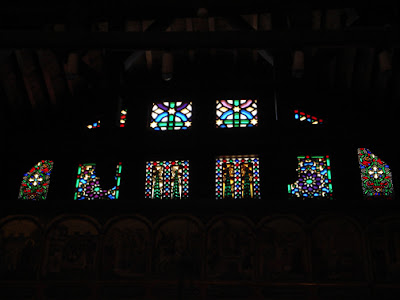
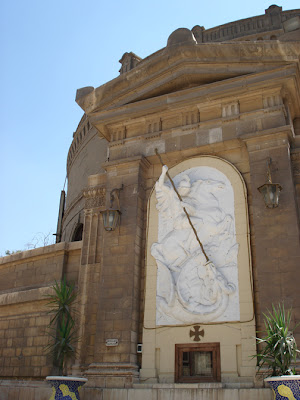
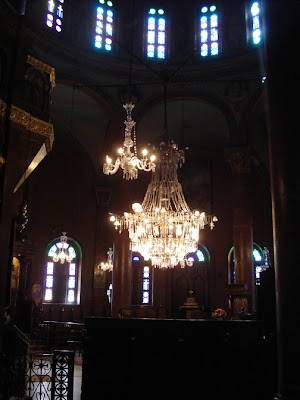
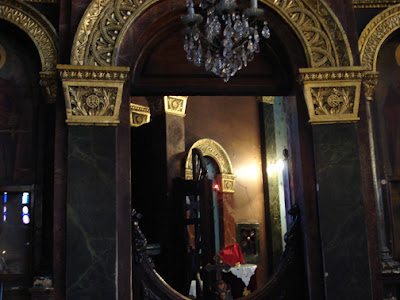
I didn't get as educated as I should have. There were guided tours of other churches, which I declined, but I was just content to look around and marvel at the architecture and the interior. The photos you see above are of St George. Notice the relief of the Saint slaying the dragon. In one part of the church, there were artifacts that showcased the methods of torture employed by the Christians during the inquisition or their campaigns into Africa. Quite gruesome.
Above is the interior, which is quite beautiful, with terribly high ceilings and great stained glass windows that were amazing against the rich dark wood of the church. There was no tour of this place, and apparently, it’s a church rarely used, since it’s so old.
Back to Egypt. Coptic Cairo was one of the first places I visited. After having arrived at my Hostel, the Lialy at 4 in the morning and woke up at 9, raring to go, I got my ISIC card. This saved me tons of money since it gives students (and teachers) discounts--up to 50% in the sites like pyramids.
I walked a lot that morning, choosing to take in polluted, congested, and cloudless Cairo by foot. I walked about 5 large blocks until I gave up, had really no idea where I was going, and jumped into a cab. The cab drivers in Egypt are a crazy sort. You can't really tell in the following video, because I probably got into the most sober driver in all of Egypt, but they are phanatical about using their tooters!
There was one time when I was in miserable Dahab at around 4 in the morning looking for a hostel that I could afford, when our cab was on this long stretch of empty highway (which pretty much sums up Dahab) and the guy could not stop honking his horn. No joke. Not a soul in sight, not a car crossing our path, not a sheep or goat to make the constant petting of his tooter justified. And! here's the kicker. Nobody uses headlights there. Ask anyone. Sure, maybe when there's a truck or bus bigger than theirs, they will put on their headlights. But once they have passed each other, they go back off. Don't ask me. I was just a stranger there who could not speak Arabic enough to say ”Watch the F*%$ out!”
So after getting my ID card, I crossed a little foot bridge that went over the Nile and after having lunch on one of those floating restaurants that you see below, I walked over to Coptic Cairo. Not before, however, getting mildly lost (a novelty for me still, at that time) and wandering into the poorer quarters of Egypt with dusty streets, mangy dogs, people conducting domestic business in the open air. I think I saw a goat wandering around, too.

I didn't take any photos, sorry, but I don't really like calling attention to myself by calling attention to people as if they were some sort of attraction. Suffice it to say, though, that they were kids just as any kids should be—playing in the streets and running around in flip flops, some barefoot, wearing their white kaftans (is that what they're called?).
I didn't need to break out my camera, however, to be singled out and gawked at. But still, I would just the same avoid stopping to look at people and take pictures of them going about their business as if to say that in my world, I did the same thing but not in such squalid conditions.
Finally, I got to Coptic Cairo at about noon, which is wonderful on your first day in a country that is so dry that even though it’s 101°F, you’re not sweating as much as you logically should. You do learn to walk a little slower and appreciate a whisper of wind against the back of your neck.
But the area was nice with some shady trees by the roadside. It was really just a couple of streets with historic churches, mosques, and Jewish temples lined up one after another. Some of them, at least the Church of St George, boasts being the oldest Church in Egypt.


I didn't get as educated as I should have. There were guided tours of other churches, which I declined, but I was just content to look around and marvel at the architecture and the interior. The photos you see above are of St George. Notice the relief of the Saint slaying the dragon. In one part of the church, there were artifacts that showcased the methods of torture employed by the Christians during the inquisition or their campaigns into Africa. Quite gruesome.
Above is the interior, which is quite beautiful, with terribly high ceilings and great stained glass windows that were amazing against the rich dark wood of the church. There was no tour of this place, and apparently, it’s a church rarely used, since it’s so old.
Subscribe to:
Posts (Atom)